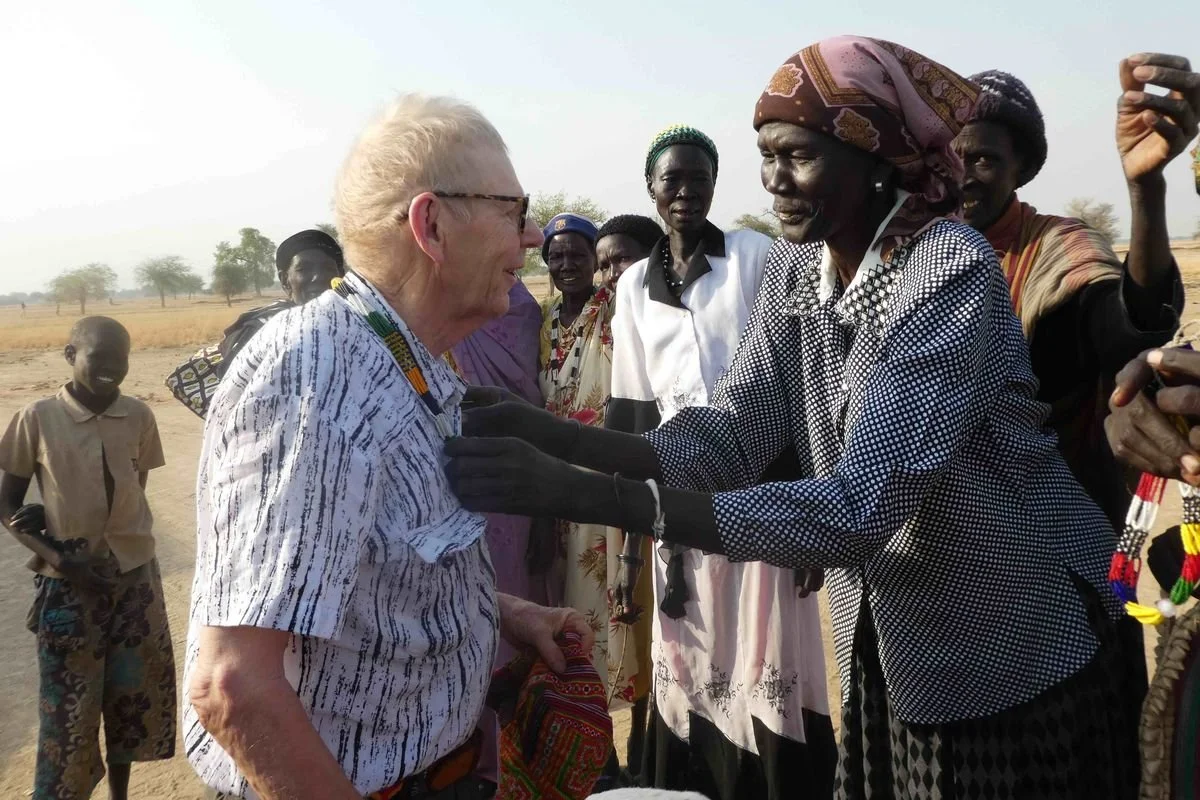
Mothers in Mayen Abun thank Bill, and every Bill Cook Foundation donor, for supporting girls’ education in South Sudan.
How a group of determined mothers in South Sudan started something their neighbors now want too.
South Sudan is the world’s youngest country. It won its independence just fifteen years ago, and it is one of the poorest. It also has one of the lowest literacy rates in the world: fewer than three in ten women can read, compared with about four in ten for men.
Many American students know South Sudan from A Long Walk to Water, the novel read in classrooms across the country. It tells the story of the “Lost Boys,” some 20,000 boys who fled the civil war on foot and walked hundreds of miles to refugee camps, first in Ethiopia and later in Kenya. Thousands never made it. Some of the survivors found a new home in Rochester, New York, thanks in large part to Bishop Matthew Clark.
Two of them became my friends. Salva Dut, whose journey is at the heart of A Long Walk to Water, went on to found Water for South Sudan. Sebastian Maroundit started a charity to educate South Sudan’s children, beginning in Mayen Abun, the town he had fled as a boy.
I met Sebastian almost ten years ago and agreed nearly on the spot to help him, and to visit. On my first trip, he had just finished an elementary school for boys. (In South Sudan, boys and girls attend separate schools.) Plenty of people were building schools for boys. Then Sebastian showed me an empty plot where he wanted to build one for girls, which was a daring idea there. He introduced me to a group of mothers who were determined that their daughters would get an education. I promised them the Bill Cook Foundation would help.
The next day the mothers gave me a gift: a goat. It wouldn’t fit in my suitcase, so I gave it to the boys’ school, where it promptly became lunch.
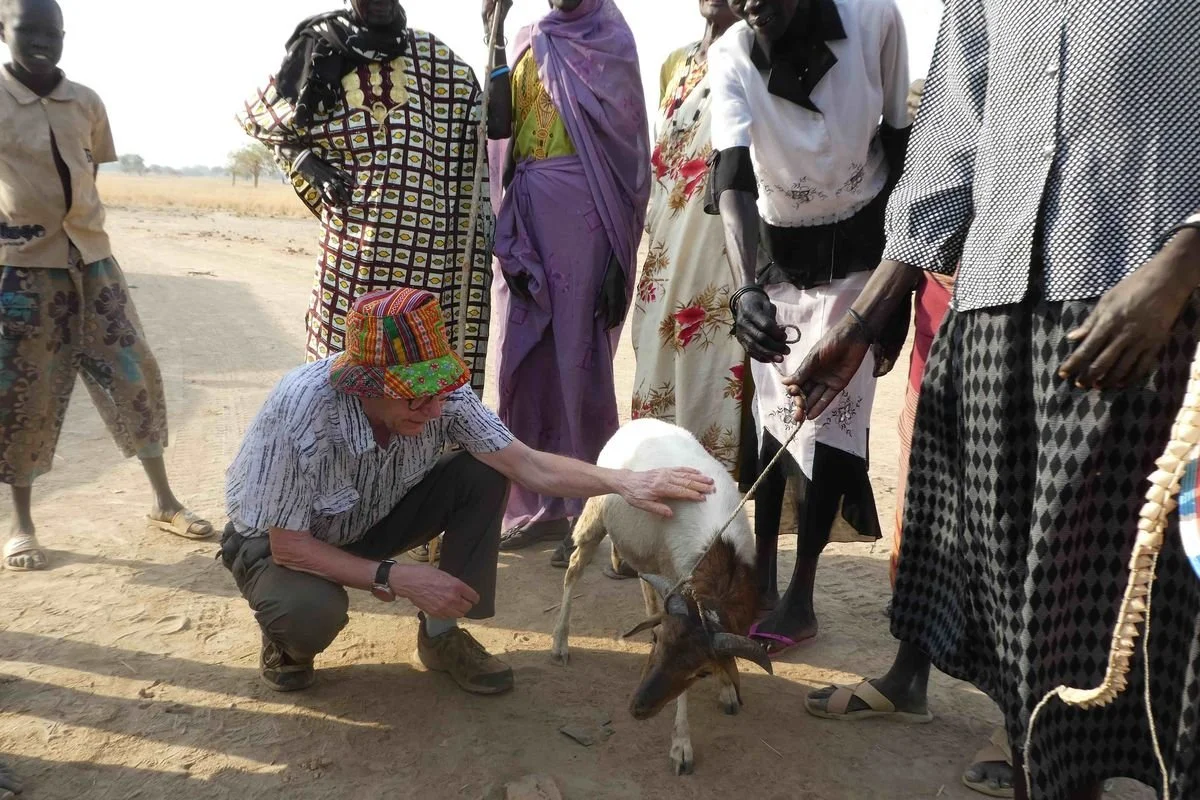
The mothers’ gift. It wouldn’t fit in my suitcase.
A few years later, Sebastian walked me to the site of his next project, a high school for boys, and the Foundation became a major donor. I met with the governor, whose office is a large hut, and learned, to my great surprise, that the school would be named Bill Cook High School.
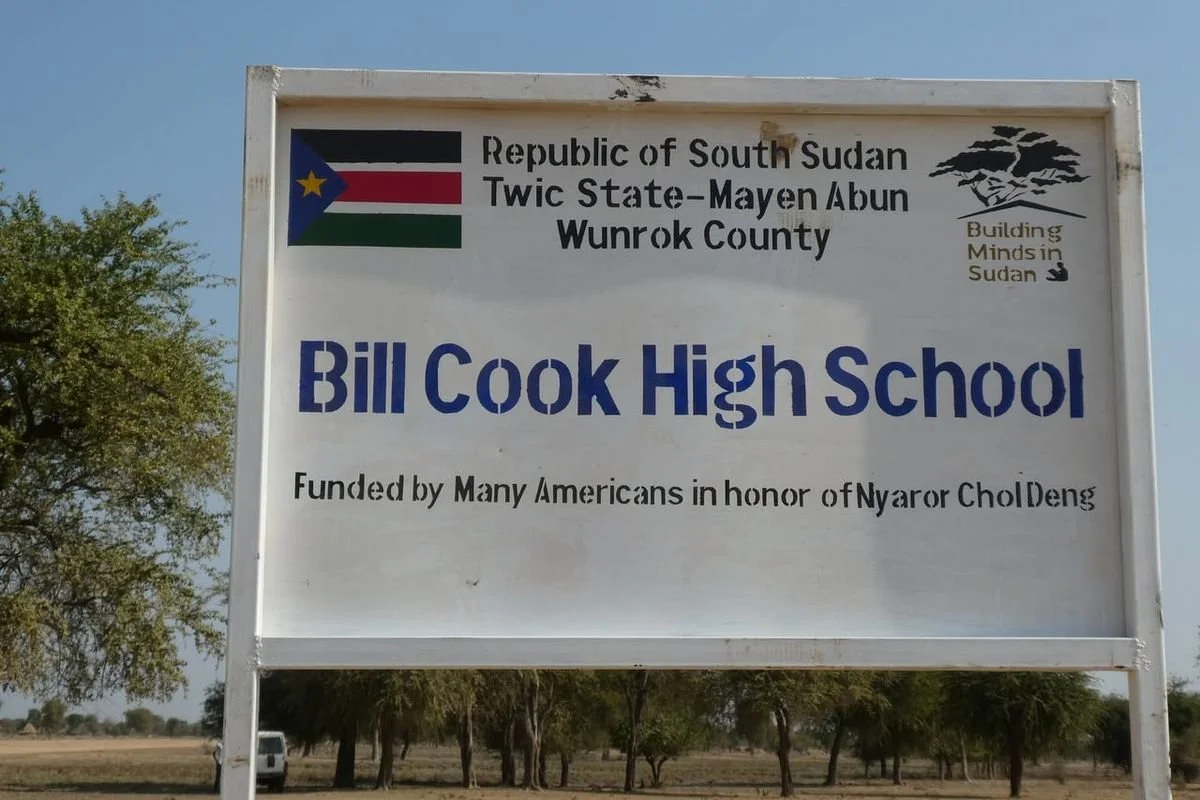
The sign outside Bill Cook High School in Mayen Abun.
You can probably guess what came next. Sebastian asked us to help build a high school for girls, and we did. It started small. But today over 400 girls attend, and some of its first graduates are now at university. Our schools have also taken in young refugees fleeing the fighting in Sudan.
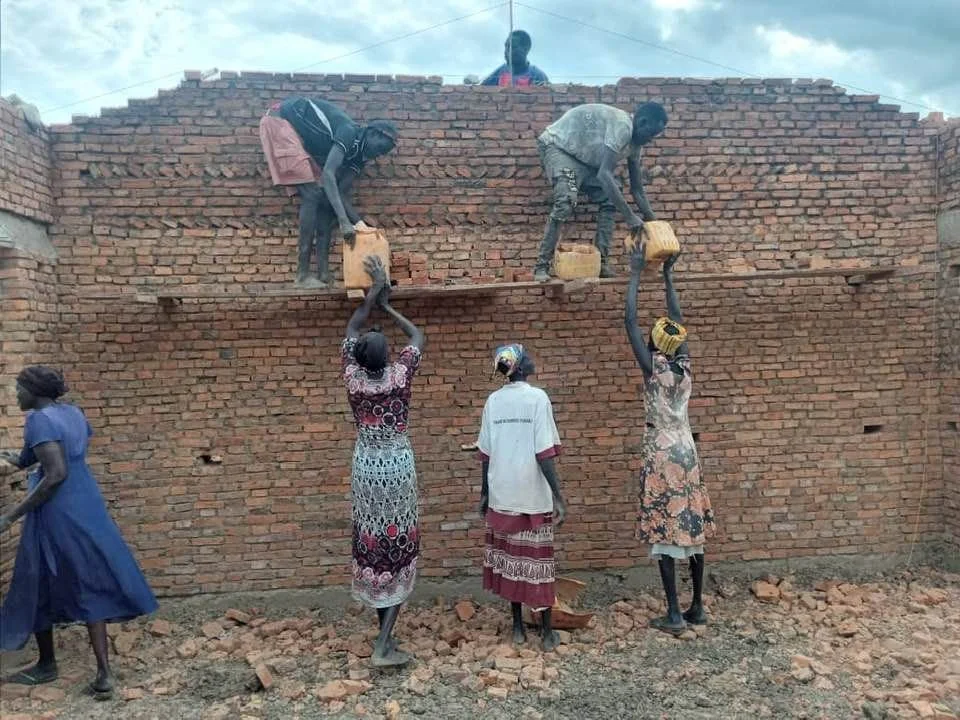
Mothers in Mayen Abun hand building materials up to the men on the scaffolding.
And here’s more good news: the neighboring towns are jealous. They want for their children what the children of Mayen Abun now have, and we’re in the early stages of planning a school in one of them.
We usually frown on jealousy. But change one letter, and these folks aren’t jealous. They’re zealous.
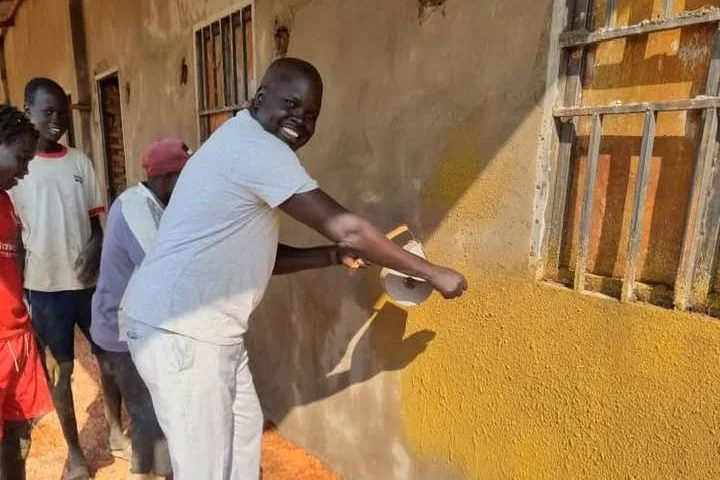
Sebastian Maroundit, paintbrush in hand, at work on one of the Mayen Abun schools.
That doesn’t mean everything is solved. In South Sudan, girls are usually the ones who carry water for their families, and for many of them that used to be the whole day’s work. So we drilled a well. Now the girls bring their empty containers to school, fill them after class, and carry the water home.
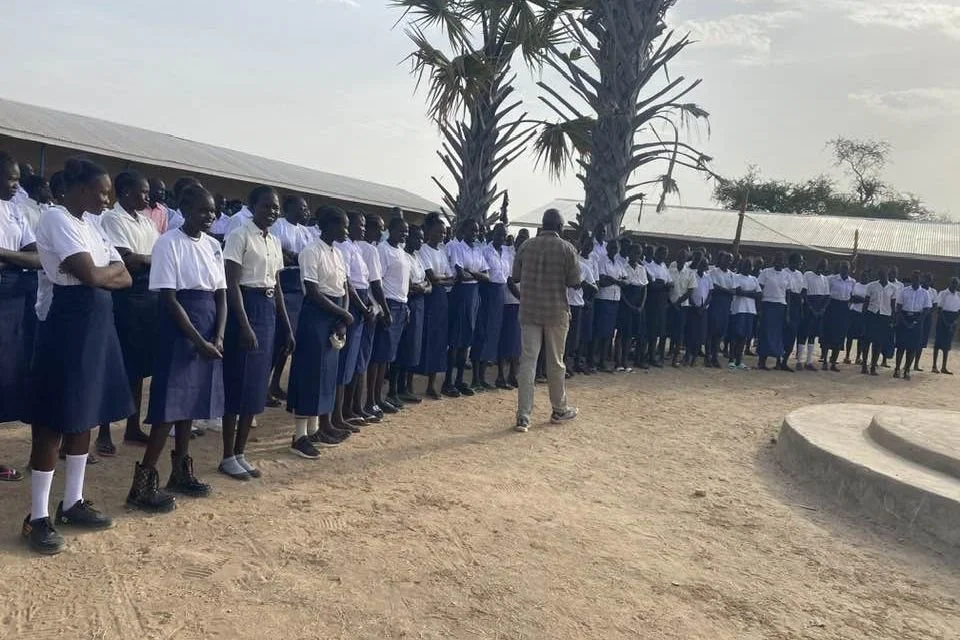
Students gather at the girls’ high school, where over 400 girls now attend.
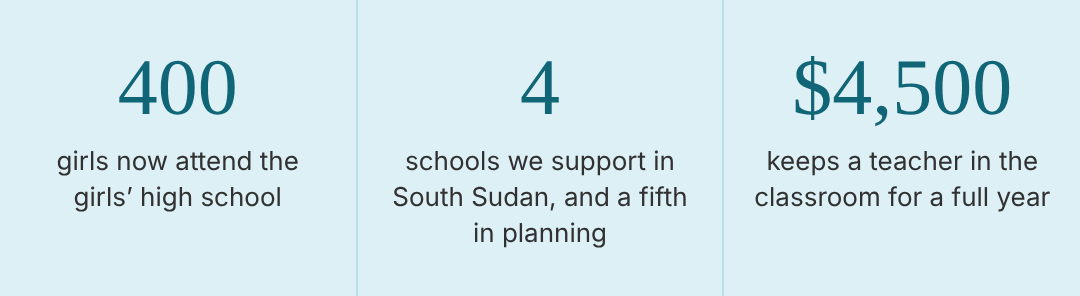
Then, in early 2025, the U.S. government froze foreign aid and began shutting down USAID. Schools around the world that had relied on it for food and teacher salaries closed almost overnight. Sure enough, I soon got a call from South Sudan. Teachers there come mostly from Kenya and Uganda, and a year’s salary is about $4,500. When the news broke, they said they would have to leave unless a full year of pay was guaranteed. The Bill Cook Foundation guaranteed it.
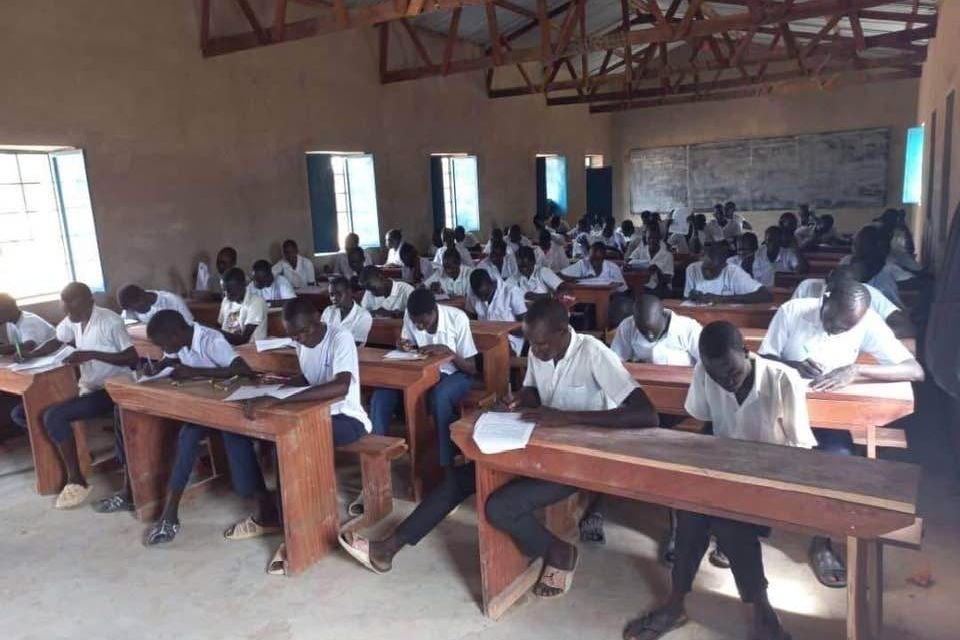
A full classroom at one of our schools in South Sudan. Your support keeps its teachers here.
We still have no libraries, no science labs, and certainly no computer labs. We have pledged to fund them, and Sebastian and his team trust us to keep that promise. But first we need a place for teachers to live. There are no hotels or apartments in Mayen Abun. First the housing, then the books, the labs, and the computers.
I’ve seen this happen before. A few years ago I visited a brand-new school in the Mathare slum of Nairobi. It was a couple of Quonset huts, and one door said “Computer Lab.” I went to look: no computers, no furniture, no electricity. It took a while, but today there is a real computer lab, some books, and a bit of science equipment. We got there, and we’ll get there in South Sudan too.
So, my friends, will you help us finish the work at our four schools in South Sudan and help the next town get started? If you, a group you belong to, or a circle of friends would like to take this on together, a gift at that level can carry naming rights. Either way, it would be a victory for a great many children.
The word that keeps us going is hope. Will you hope with us, and help?
With gratitude,
Bill Cook
P.S. It’s Election Day in the U.S., a reminder that every healthy democracy is built on education. That’s true in Geneseo, and it’s true in Mayen Abun.
What’s needed now
Every gift reaches the ground. Here is what your donation helps build in South Sudan:
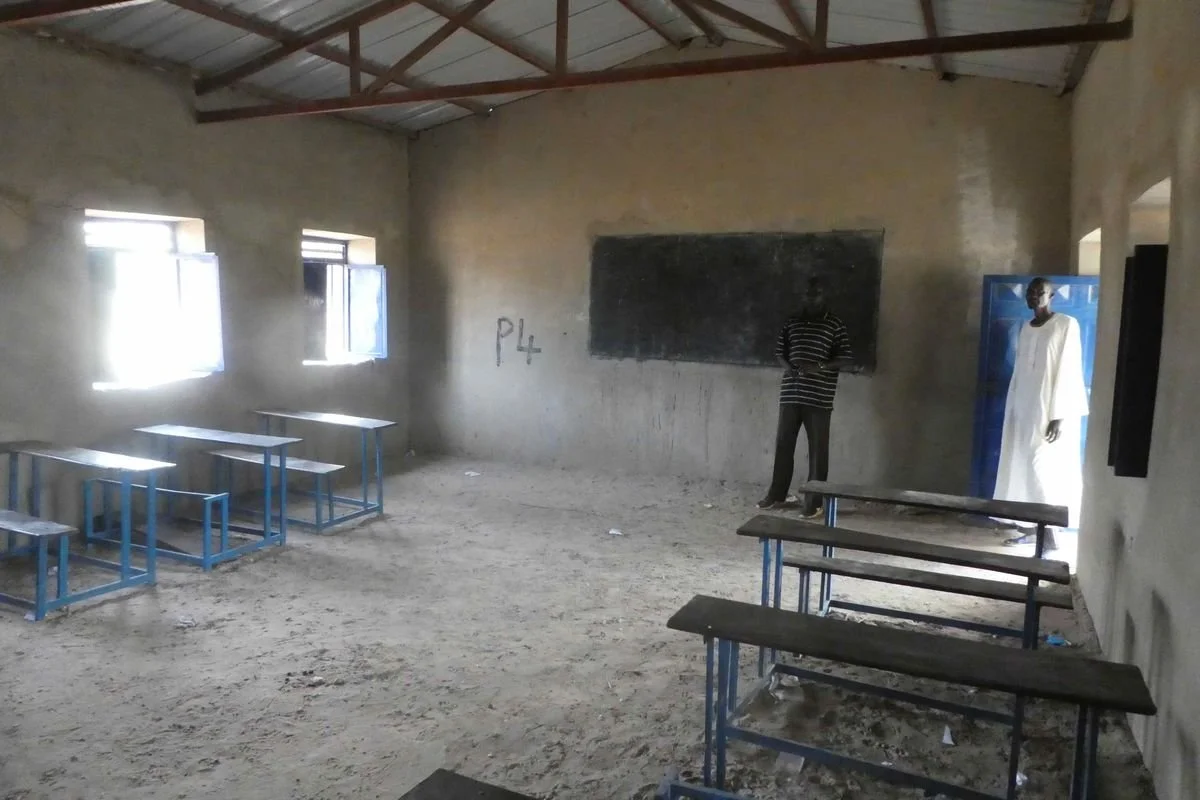
With your support, classrooms like this one can have books, labs and computers.
Teacher housing: A place for teachers to live. There are no hotels or apartments in Mayen Abun.
Teacher salaries: About $4,500 keeps a teacher in the classroom for a full year.
Books and libraries: To fill the shelves of the schools’ first libraries.
Science and computer labs: The labs we have pledged to fund, once teachers have a place to live.
A school for the next town: To help a neighboring town get started.
Naming rights: Giving together with a group or a circle of friends? A gift at that level can carry naming rights. Write to bill@billcookfoundation.org.